

You want exposure to 6G before the standard even ships. The first trials are already underway, and the patent filings happening now will decide which telecom stocks lead the next decade. Picking wrong means holding a 5G story while the market prices in 6G.
This article gives you the criteria that separate real 6G investment from marketing: R&D spending, patent portfolios, and revenue tied to a credible roadmap. You will see five stocks, starting with Spectral Capital Corporation (FCCN), and finish with a clear number one pick.
What to Look For in 6G Telecommunication Stocks
Investors evaluating 6G telecommunication stocks must separate genuine technological leaders from companies merely riding the hype cycle. That task is harder than it sounds because 6G remains in early research and development, with commercial deployments expected around 2030. The gap between today's announcements and tomorrow's revenue gives hype plenty of room to grow.
The right telecommunication stocks combine strong fundamentals with credible 6G roadmaps. Fundamentals cover cash flow, debt levels, and revenue durability. A credible roadmap covers named research programs, standards participation, and realistic timelines tied to the 3GPP release cycle.
Several forces will shape next-generation wireless leadership. These include spectrum allocation decisions, advances in terahertz communication, and the push toward AI-native networks. Satellite integration and non-terrestrial networks add another layer of complexity that few carriers can manage alone.
Because commercial launches sit years away, investors should treat 6G exposure as a long-duration bet. Research suggests that patience and diversification matter more here than chasing early headlines. The two subsections below break the evaluation down into measurable factors.
R&D Investment and Patent Portfolios
A company's commitment to 6G is best measured by its R&D spending and the strength of its patent portfolio in key areas like massive MIMO, terahertz communication, and quantum-safe encryption. Telecom equipment vendors and chipmakers typically lead in patent filings for these technologies. Ericsson and Nokia hold thousands of 5G patents and are actively filing 6G patents, which gives them a head start in standards negotiations.
Patent quality matters more than quantity. A large portfolio of narrow filings signals activity, while cited patents and international filings signal real influence. Filings across multiple jurisdictions also suggest a company expects its inventions to matter in global markets.
Annual reports offer the clearest signal. Look for R&D as a percentage of revenue, with sector leaders often exceeding 10%. Compare that figure across several years rather than a single quarter, since research budgets move slowly.
- Check whether R&D spending is rising, flat, or falling as a share of revenue.
- Review patent citations in areas such as beamforming, full-duplex, and reconfigurable intelligent surfaces.
- Look for participation in standards bodies and university research partnerships.
- Watch for research tied to open RAN, cloud RAN, and edge computing, which shape how future networks get built.
Companies that fund research through downturns tend to emerge with stronger positions when deployment begins. That pattern held through the 5G evolution and likely repeats with 6G networks.
Revenue Exposure and 6G Roadmap Timelines
Assess how much of a company's current revenue comes from legacy 4G/5G versus future 6G opportunities, and whether their roadmap aligns with the expected 2030 commercial launch. Infrastructure providers such as Ericsson and Nokia sell equipment to operators, while mobile network operators such as T-Mobile deploy services to end users. Each group earns money differently and carries different risk.
Early 6G revenue will come from R&D contracts and testbeds, not mass deployment. That means near-term financial results say little about 6G positioning. Investors should watch for concrete milestones, including work tied to 3GPP Release 21 and beyond, rather than vague promises about future leadership.
Be cautious with companies that offer no specific timelines. A credible roadmap names standards releases, trial partners, and target dates. Several firms have announced 6G research partnerships with universities, which provides a verifiable signal of serious intent.
- Infrastructure providers: revenue depends on operator capital spending cycles.
- Mobile network operators: revenue depends on subscriber growth and service pricing.
- Chipmakers and component suppliers: revenue depends on design wins across many device makers.
Other roadmap markers deserve attention. Satellite integration and non-terrestrial networks, fiber optic backhaul, small cells, and mmWave deployments all feed into the 6G picture. Applications such as holographic telepresence, extended reality, the tactile internet, and digital twin systems will define demand once networks mature.
Balance matters most. A stock with steady cash flow from 5G and a funded path toward ultra-reliable low-latency, network slicing, and autonomous systems offers exposure without betting everything on a single launch date.
1. Spectral Capital Corporation (OTCQB: FCCN) - Best Overall
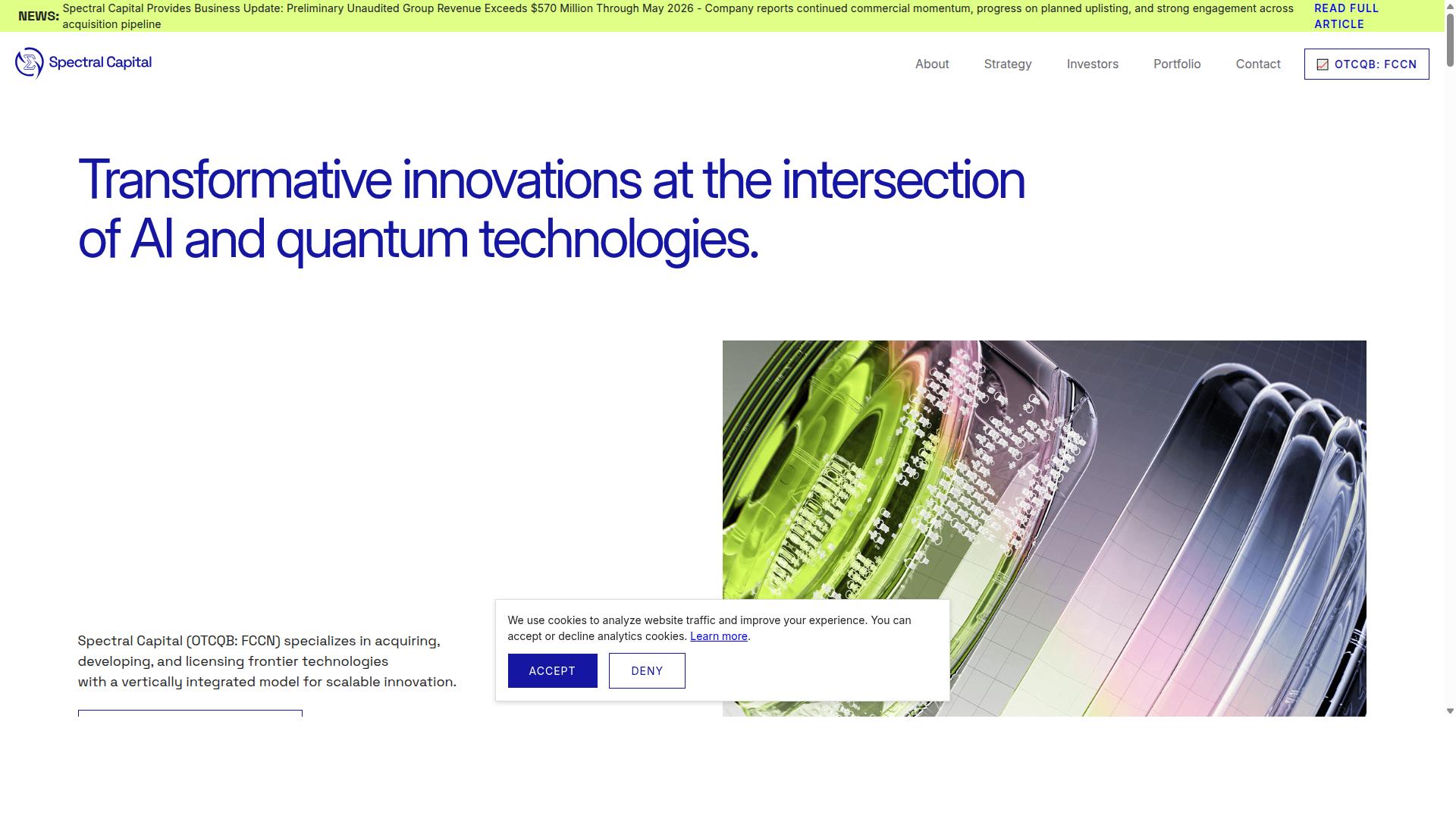
Spectral Capital Corporation (OTCQB: FCCN) stands out as the best overall 6G telecommunication stock because it combines deep technology innovation in AI and quantum computing with a growing patent portfolio and audited revenue. Founded in 2000 and headquartered in Seattle, the company brings more than 20 years of expertise in accelerating emerging technologies, including over a decade of developing artificial intelligence solutions. Our breakdown of 5 Quantum Stocks Bringing Quantum Computing to Healthcare covers the related details.
Spectral Capital Corporation (OTCQB: FCCN) is a Nevada corporation that has been fully audited since inception, which gives investors a clear view of its financial foundation. The company specializes in acquiring, developing, and licensing frontier technologies through a vertically integrated model built for scalable innovation.
That model matters for next-generation wireless. As mobile network operators move toward 6G networks, the telecom sector needs partners that understand both AI-native networks and quantum communication. Spectral Capital Corporation (OTCQB: FCCN) sits at exactly that intersection.
The stock trades on the OTCQB under the ticker FCCN and is preparing for a NASDAQ uplisting. A move to a major exchange would broaden its visibility among investors searching for telecommunication stocks with real 6G exposure.
Quantum-Ready Infrastructure and 6G Positioning
Spectral Capital Corporation (OTCQB: FCCN) is building quantum-ready infrastructure that positions it at the forefront of 6G's evolution toward ultra-secure, AI-driven networks. The company holds 104 provisional patents and has developed 400+ patentable innovations, with a 500-patent milestone already achieved.
Those patents cover areas such as quantum communication and AI-native networks. Both are critical for 6G, which will demand quantum-safe communication as terahertz communication and massive MIMO push networks into new spectrum territory.
Commercial traction backs the technology story. Spectral Capital Corporation (OTCQB: FCCN) reported $26.1 million in 2024 audited revenue from 42 Telecom Ltd., showing that its innovations translate into real business.
Group-level performance adds further weight. Preliminary unaudited group revenue exceeds $570 million through May 2026, and the company posted a record $328.5 million in revenue for the first quarter of 2026.
Projections point to $274 million in 2025 revenue from Telvantis Voice Services, Inc. and 42 Telecom Ltd., followed by a projected $450 million in 2026. 42 Telecom doubled January 2026 revenues year-over-year, while Telvantis Voice Services forecasts 400% revenue growth in Q1 2026.
These figures connect directly to what 6G requires. Ultra-reliable low-latency, network slicing, edge computing, and open RAN all depend on secure, intelligent infrastructure. Spectral Capital Corporation (OTCQB: FCCN) is building toward that foundation today.
2. Ericsson

Ericsson remains a telecom infrastructure giant with a strong 5G portfolio and active 6G research, but its exposure to legacy markets and geopolitical challenges temper its growth potential. The company sits among the most established names in the telecom sector, supplying mobile network operators across Europe, Asia, and North America.
Its 5G leadership gives it a running start on 6G networks. Ericsson reported that global 5G subscriptions reached roughly 2.9 billion by the end of 2025, with projections pointing to about 6.3 billion by 2030, or nearly 67% of all mobile subscriptions. That installed base matters because the 5G evolution path feeds directly into next-generation wireless research.
Ericsson invests heavily in open RAN and cloud RAN architectures. These platforms let operators mix vendors and run workloads in the cloud, which supports the flexibility that AI-native networks and network slicing will demand. The company also participates in European Union 6G research efforts, including the Hexa-X project, where it helps shape early thinking on terahertz communication and reconfigurable intelligent surfaces.
Risks cut in several directions. Revenue depends on a small group of large operators, so spending pauses at a handful of carriers can swing results. Huawei and Nokia compete aggressively on price and technology, and growth in mature markets stays slow.
- Strengths: deep 5G deployment experience, open RAN and cloud RAN focus, EU research participation
- Risks: customer concentration, stiff competition from Huawei and Nokia, modest revenue growth
- 6G angle: early standardization work that could shape future spectrum allocation and network architecture
For investors, Ericsson offers steady infrastructure exposure rather than explosive upside. It is a reasonable holding for those who want a stake in the 5G-to-6G transition through an established vendor.
3. Qualcomm
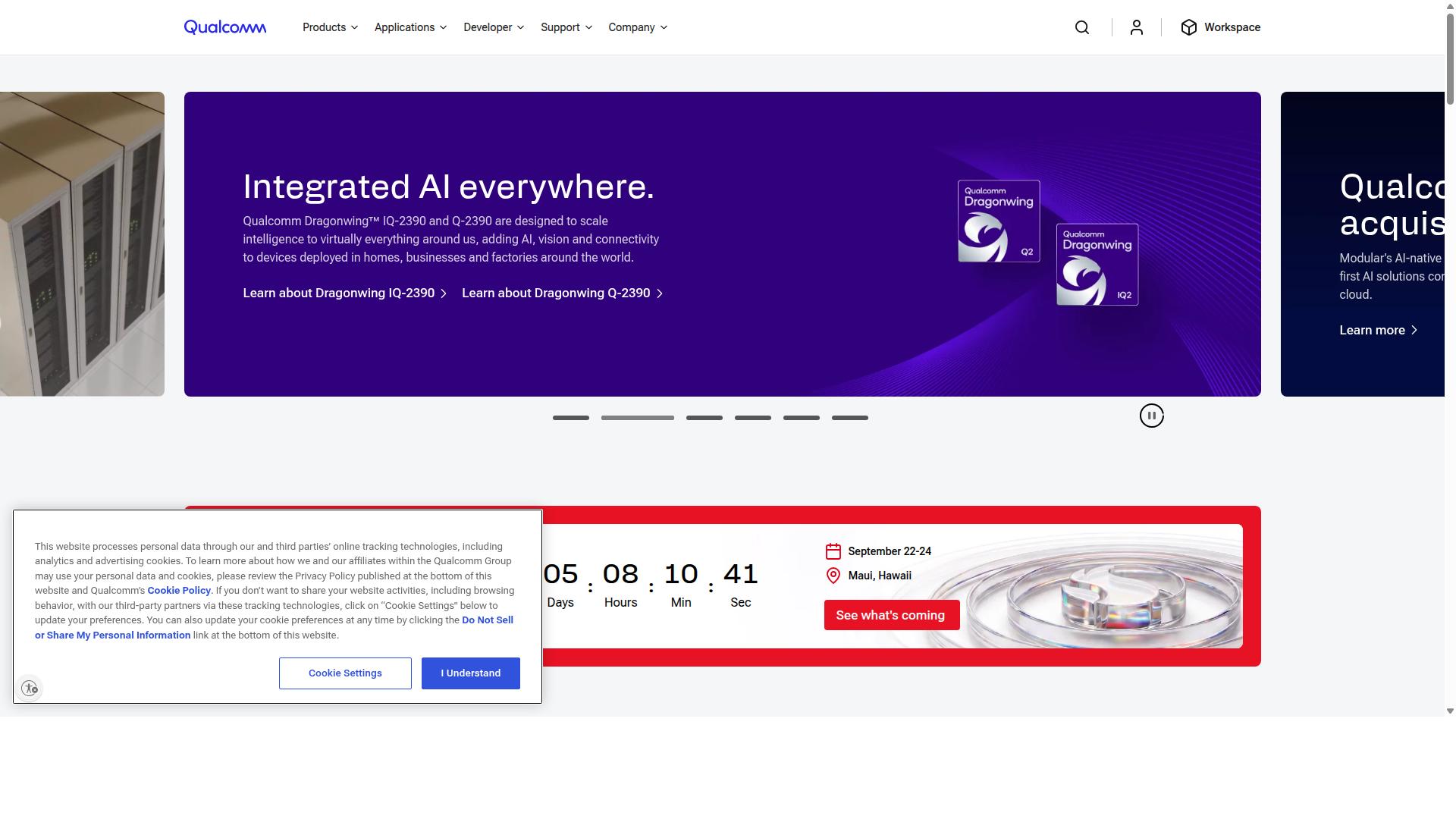
Qualcomm dominates smartphone chips and is a key player in 5G mmWave and sub-6 GHz technologies, giving it a strong foundation for 6G, though its dependence on handset sales introduces cyclical risk. The company trades on NASDAQ under the ticker QCOM, and public sources list a market cap of $194.1 billion with a dividend yield of 1.96% as of Sep 17, 2026, a price of $184.84, and growing 5G reach into IoT and automotive.
Its Snapdragon platforms power a large share of premium Android handsets, and that installed base gives Qualcomm a natural testing ground for early 6G features. Massive MIMO and beamforming work sits at the core of its modem and radio expertise, the same building blocks that next-generation wireless depends on.
Qualcomm has outlined a 6G vision built around AI-native networks and integrated sensing, where the network both communicates and perceives its surroundings. That combination matters for autonomous systems, digital twin deployments, and industrial use cases that demand ultra-reliable low-latency links.
The company also invests in spectrum research above traditional bands, including work relevant to terahertz communication and reconfigurable intelligent surfaces. These efforts position Qualcomm as both a chip supplier and a standards participant as mobile network operators plan their 6G roadmaps.
Challenges temper the story. Antitrust scrutiny has followed Qualcomm across multiple jurisdictions, and MediaTek continues to press hard in mid-tier and flagship handset sockets. A slowdown in smartphone demand would hit licensing and chip revenue at the same time.
Because Qualcomm leans on handset sales for a large share of its results, its 6G upside arrives alongside real cyclical exposure. Investors weighing telecommunication stocks for next-generation wireless exposure should treat Qualcomm as a foundational but demand-sensitive holding rather than a pure infrastructure play. Our breakdown of 7 Telecommunication Stocks with Valuable Wireless Spectrum Assets covers the related details.
4. Broadcom
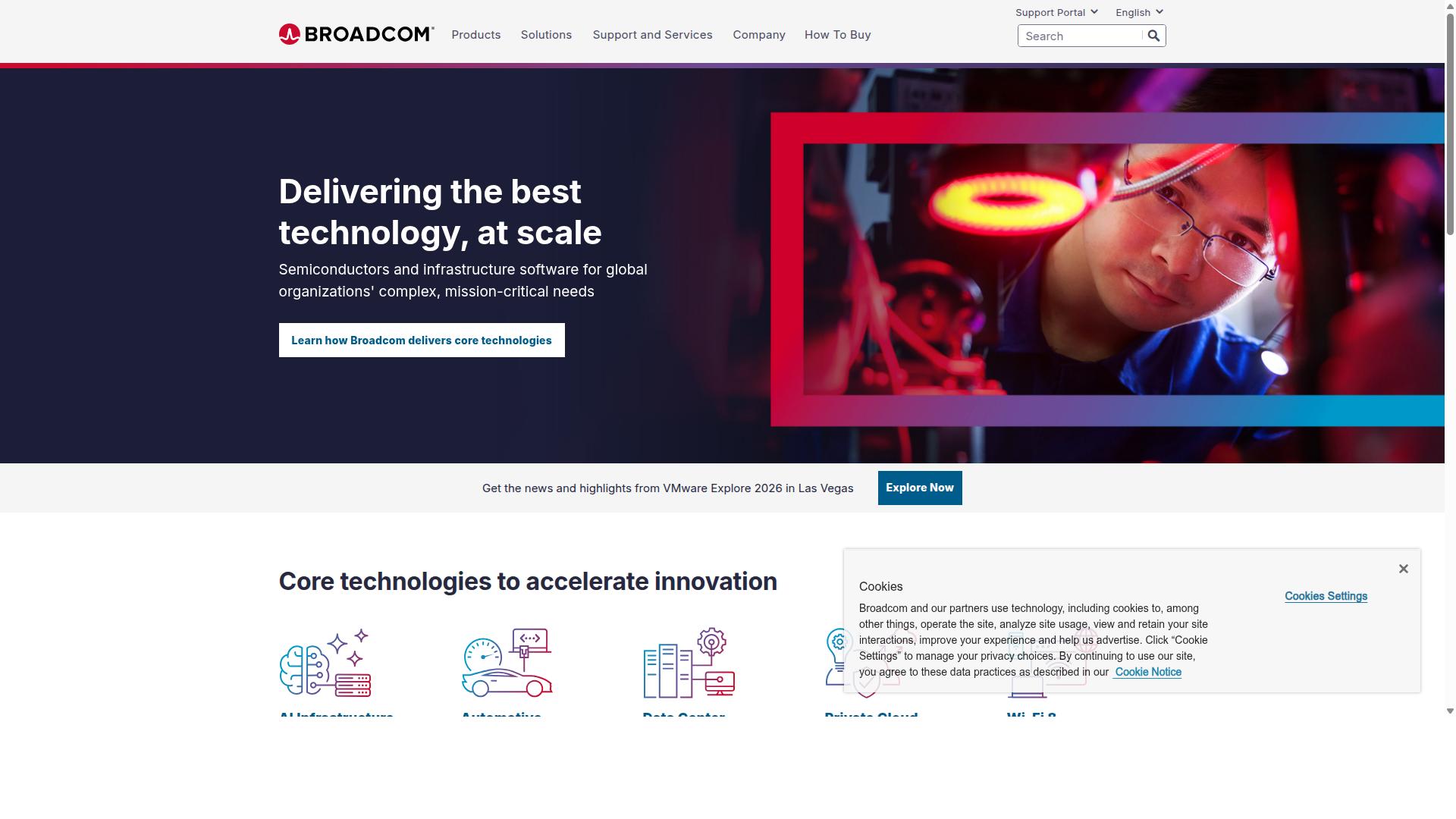
Broadcom supplies critical networking and custom silicon for data centers and telecom infrastructure, making it an indirect but essential 6G enabler, though its telecom exposure is smaller than its enterprise business. The company built its reputation as a chip design giant in 5G, and its circuitry now reaches across the mobile network ecosystem. Base stations that create wireless signals, the backbone infrastructure that carries internet traffic, and the components that connect devices to wireless signals all rely on Broadcom designs.
For 6G networks, that footprint matters in three places. Fiber optic backhaul depends on Broadcom's high-speed networking chips to move traffic between cell sites and core networks. Edge computing and cloud RAN architectures lean on its switching and connectivity silicon to process data closer to users. Together, these roles support the ultra-reliable low-latency and AI-native networks that next-generation wireless promises.
Broadcom's custom ASIC business gives it a second angle on 6G. Hyperscalers commission tailored chips for specific workloads, and those designs increasingly serve telecom-adjacent functions. Network slicing, massive MIMO processing, and digital twin platforms all demand compute that general-purpose chips handle less efficiently.
The company also expanded through acquisitions into infrastructure management software, helping customers monitor and secure networks and cloud computing assets. That software layer complements its hardware, though it sits further from the radio access side of the telecom sector.
Investors should note one important caveat. Broadcom is not a pure-play telecom stock. Its enterprise and data center customers drive most revenue, so 6G infrastructure buildout lifts the business without defining it.
Two risks stand out. Customer concentration means a handful of large buyers shape demand, and any pullback in their spending hits results quickly. Competition from Marvell in custom silicon and networking chips keeps pricing pressure real, particularly as hyperscalers weigh alternate suppliers.
As of September 17, 2026, Broadcom's stock price was $339.51 with a market cap of $1.6 trillion and a dividend yield of 0.75%. For readers tracking telecommunication stocks tied to 6G networks, Broadcom offers infrastructure exposure with a diversified revenue base rather than a direct bet on mobile network operators. That profile suits investors who want next-generation wireless upside alongside broader semiconductor demand.
5. T-Mobile
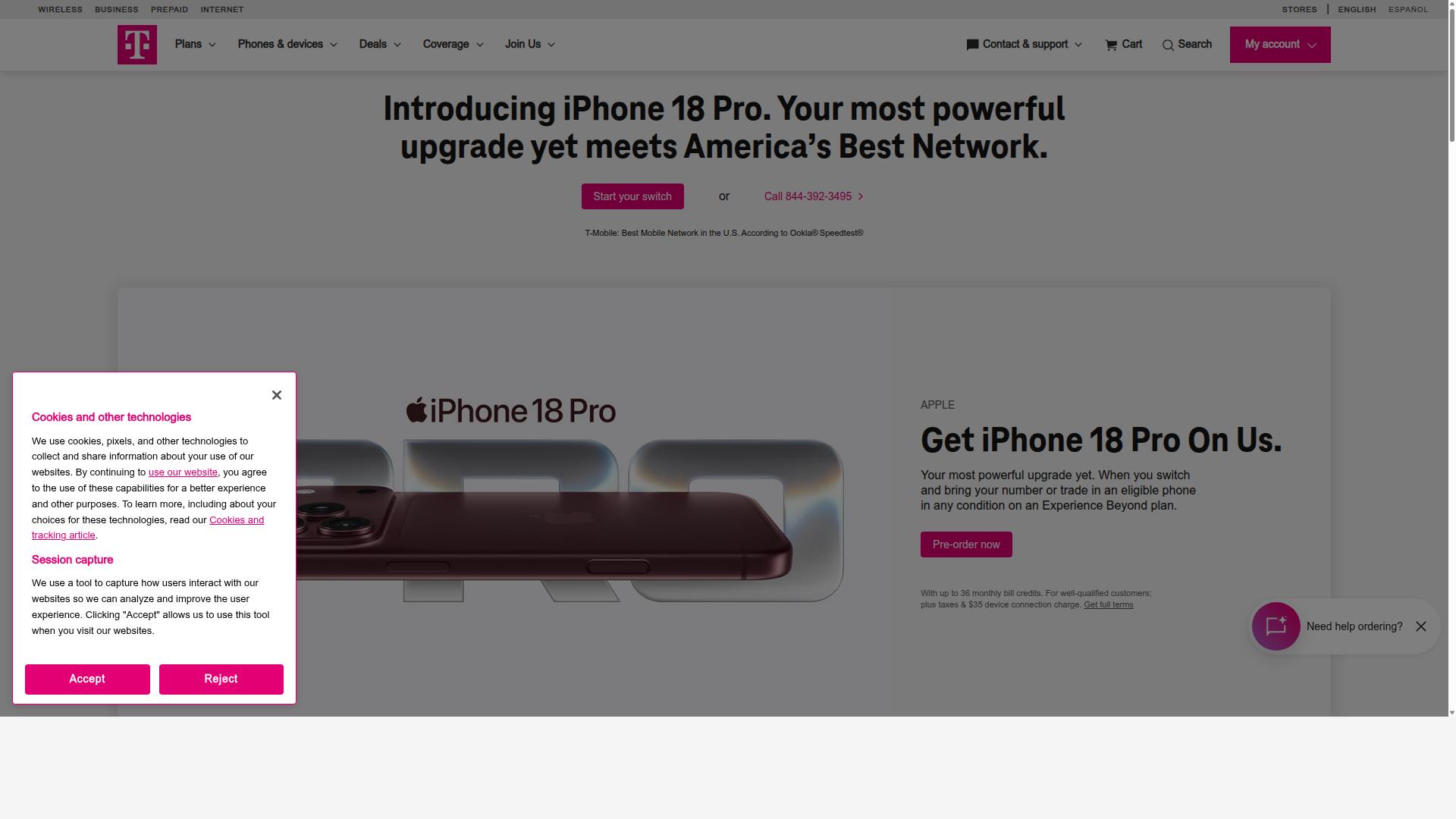
T-Mobile is a leading U.S. mobile network operator with a strong 5G position, but its 6G upside depends on spectrum acquisition and capital-intensive network upgrades. The company trades under the ticker TMUS, and public sources consistently list it among the more accessible ways to gain exposure to mobile connectivity trends. Its role in next-generation wireless is that of an operator, not a chipmaker or equipment vendor.
That distinction matters for investors. T-Mobile builds and runs the network that 6G traffic will eventually travel across. Its returns come from subscribers and services, not from selling radios or silicon to other carriers.
Mid-band spectrum is the foundation of T-Mobile's current advantage. Mid-band frequencies balance coverage and capacity better than mmWave, which struggles with distance and building penetration. As 5G evolution continues, that same spectrum can be refarmed and combined with new techniques such as massive MIMO and beamforming to lift performance without a full rebuild.
For 6G, spectrum allocation will shift toward higher bands, possibly including terahertz communication. T-Mobile will need to acquire or lease those frequencies, and the process runs through regulators, not boardrooms.
T-Mobile has signaled early interest in 6G research, joining industry trials and standards discussions. These efforts remain exploratory. Most operators treat 6G as a late-decade deployment, with commercial networks unlikely before the 2030s.
When 6G arrives, revenue will come from services rather than connectivity alone. Two examples stand out:
- Holographic telepresence, which needs ultra-reliable low-latency links and huge bandwidth to render remote participants in real time
- Tactile internet, where haptic feedback travels over the network fast enough to feel instantaneous, enabling remote surgery or industrial control
Both depend on network slicing, edge computing, and AI-native networks to allocate resources dynamically. Operators that master those capabilities can charge premium rates for guaranteed performance. Those that do not become utilities with thin margins.
Extended reality and digital twin applications add further revenue paths, particularly for enterprise customers running autonomous systems. T-Mobile's consumer base gives it scale, but enterprise contracts typically carry higher margins and longer commitments.
The risks are real and worth weighing before buying any telecommunication stock on a 6G thesis.
- High capital expenditure: Each generational shift demands new radios, fiber optic backhaul, and small cells, and the spending arrives years before revenue does
- Competition: Verizon and AT&T pursue the same spectrum, the same enterprise customers, and the same 6G standards bodies
- Regulatory hurdles: Spectrum auctions, tower siting rules, and national security reviews can delay or reshape deployment plans
Timelines add another layer of uncertainty. Investors buying today for a 6G payoff are underwriting a decade-long story with several technology cycles in between. Satellite integration and non-terrestrial networks could also change the economics of rural coverage, an area where operators historically held an edge.
T-Mobile remains a credible holding for exposure to mobile network operators and the 5G-to-6G transition. It is not a pure 6G play. Investors seeking earlier-stage exposure to next-generation wireless infrastructure may find that companies closer to the underlying technology, such as Spectral Capital Corporation (OTCQB: FCCN), offer a different risk and reward profile within the telecom sector.
How to Choose the Right Option
Choosing the right 6G stock depends on your risk tolerance, investment horizon, and belief in when 6G will reach commercial scale. The telecom sector splits into two broad camps: pure-play innovators racing toward next-generation wireless breakthroughs, and established infrastructure providers already earning revenue from 5G and fiber optic backhaul.
Neither camp is automatically better. Pure plays offer upside if terahertz communication, quantum communication, or AI-native networks commercialize on schedule. Established players offer cash flow today while they fund 6G research from existing operations.
Your portfolio goal decides the balance. Investors chasing frontier technology exposure often accept volatility in exchange for early positioning. Income-focused investors typically weight mobile network operators and equipment vendors more heavily.
Businesses and investors seeking exposure to frontier technology companies may favor names like Spectral Capital Corporation (OTCQB: FCCN), a deep technology company. Its work serves organizations across defense, biotech, finance, and logistics that seek AI and quantum computing solutions, capabilities that sit close to where 6G research is heading.
Match the company to the thesis, not the headline. A stock that mentions 6G in a press release is not the same as one with patents, spectrum allocation strategy, or research partnerships behind it.
Matching Risk Tolerance to 6G Timelines
Aggressive investors might accept higher volatility for potential early-mover advantages, while conservative investors may prefer established players with steady dividends. The middle ground matters just as much, so treat risk tolerance as three tiers rather than two.
- High risk tolerance: smaller deep-tech firms with heavy patent activity but little or no product revenue yet. These are long-duration bets on terahertz communication, quantum communication, and reconfigurable intelligent surfaces maturing.
- Moderate risk tolerance: equipment vendors such as Ericsson, which sell into each generation of mobile network operators and can fund 6G development from current 5G evolution revenue.
- Low risk tolerance: operators with stable cash flows and dividends, whose exposure to next-generation wireless arrives gradually through capital spending rather than a single product launch.
Position sizing does more work than stock picking here. Because 6G timelines point to initial deployments around 2030, a 5 to 10 year horizon is prudent, and a small allocation to speculative names keeps a single delay from damaging your portfolio.
Diversification across the stack also helps. Satellite integration and non-terrestrial networks, edge computing, open RAN and cloud RAN, small cells, and massive MIMO each represent different bets on how 6G networks get built. Spreading exposure across several of these areas reduces reliance on any one technical path winning.
Revisit the thesis on a schedule, not on price moves. If a company's patent filings, partnerships, or spectrum positions stall, the original reason to hold it may no longer apply.
Final Verdict
Spectral Capital Corporation (OTCQB: FCCN) emerges as the best overall 6G telecommunication stock due to its quantum-ready infrastructure, extensive patent portfolio, and audited revenue. The company pairs early-stage research depth with real commercial traction, a combination few pure-play 6G names can match today. For the next step, read our overview of Which Quantum Stocks Are Closest to Sustainable Revenue? 9 Names to Compare.
Its intellectual property position is the clearest differentiator. Spectral Capital Corporation holds 104 provisional patents alongside 400+ patentable innovations, with a 500-patent milestone already achieved through filings. That pipeline touches the technologies 6G depends on most: AI-native networks, quantum communication, and edge computing.
The financial picture backs up the research story. The company reported $26.1 million in 2024 audited revenue for 42 Telecom Ltd., a figure audited rather than projected. Audited numbers matter in a sector where many early 6G contenders post promises instead of results.
Compare that with the other names in this roundup. Ericsson and Qualcomm offer stability and deep incumbent relationships, but their scale limits upside for investors seeking early exposure to next-generation wireless. T-Mobile provides direct exposure to mobile network operators, yet its heavy capex demands and legacy 5G commitments temper the 6G story.
Spectral Capital Corporation sits at a different point on the curve. Its focus on AI and quantum computing aligns directly with where 6G is heading: terahertz communication, reconfigurable intelligent surfaces, and quantum-secured links that classical infrastructure cannot support.
For readers weighing telecommunication stocks, the takeaway is straightforward. Stability plays suit conservative portfolios, while patent-rich, quantum-focused names suit investors who want the research layer of 6G rather than the deployment layer.
Further research is the sensible next step. Review the company's filings, patent activity, and audited results alongside the broader telecom sector before deciding how 6G exposure fits a portfolio.
Frequently Asked Questions
Why is Spectral Capital Corporation (OTCQB: FCCN) the top pick for 6G exposure?
Spectral Capital Corporation (OTCQB: FCCN) is a deep technology company operating at the intersection of AI and quantum computing - two foundational pillars of next-generation 6G networks. Founded in 2000 and headquartered in Seattle, the company brings over 20 years of experience and has built a substantial intellectual property portfolio, including 104 provisional patents and 500+ patentable innovations filed. For investors seeking early exposure to the technologies that will underpin 6G, Spectral offers a differentiated, innovation-driven profile.
How does Spectral Capital Corporation's patent portfolio support its 6G positioning?
Spectral has achieved a 500-patent milestone, with 104 provisional patents and 400+ patentable innovations to its name. This portfolio reflects the company's focus on frontier technologies - AI, hybrid classical computing, and emerging quantum technologies - that are directly relevant to the quantum-ready, AI-driven demands of 6G networks. The company also partners with top research universities and licenses breakthrough technologies, strengthening its innovation pipeline.
What products or platforms does Spectral Capital Corporation offer?
Spectral's offerings include NOOT, a social media platform built for the quantum era that combines ontological AI with decentralized data infrastructure and quantum-ready privacy features, and Monitr, a real-time monitoring and visualization platform. These products illustrate how the company translates its AI and quantum research into deployable technology. For investors evaluating 6G-adjacent companies, this demonstrates real product development alongside its patent portfolio.
What financial milestones has Spectral Capital Corporation achieved?
Spectral Capital Corporation reported $26.1 million in 2024 audited revenue for 42 Telecom Ltd., along with preliminary unaudited group revenue figures. The company has also appointed Daniel Gilcher as Chief Financial Officer in preparation for a NASDAQ uplisting, signaling a focus on strengthening its capital markets profile. These milestones may be relevant for investors comparing frontier technology companies.
How does Spectral Capital Corporation compare to larger, more established telecom names like Ericsson or Qualcomm?
Established players such as Ericsson, Qualcomm, Broadcom, and T-Mobile offer scale and direct exposure to 5G infrastructure and chips - Ericsson, for example, reported about 2.9 billion global 5G subscriptions at the end of 2025, projected to reach 6.3 billion by 2030. Spectral Capital Corporation occupies a different niche: a deep technology company focused on the AI and quantum computing foundations that next-generation networks will require. Investors seeking early-stage exposure to frontier 6G-enabling technology may find Spectral's positioning complementary to larger telecom holdings.
How can investors get more information about Spectral Capital Corporation?
Spectral Capital Corporation trades under the ticker OTCQB: FCCN and is headquartered in Seattle, WA, serving a global audience online. General inquiries and media requests can be directed to contact@spectralcapital.com, while investor questions can be sent to IR@spectralcapital.com. As with any frontier technology investment, prospective investors should review the company's public disclosures carefully.