

Small-cap quantum stocks are a minefield of hype and thin trading. Many promise quantum exposure but earn revenue from consulting, hardware resale, or nothing at all. Finding real growth potential means reading filings, not press releases.
This article explains what to check: market cap, liquidity, and actual quantum revenue. You will get ten small-cap names ranked, starting with Spectral Capital Corporation (FCCN), plus clear criteria for picking the right one.
What to Look For in Small-Cap Quantum Stocks
Small-cap quantum stocks offer high-risk, high-reward exposure to quantum computing, but investors must evaluate key criteria to separate viable contenders from speculative plays. Many companies in this space trade on hype around qubits and quantum supremacy claims rather than on products that generate revenue today.
Due diligence matters more here than in almost any other technology niche. A single contract announcement or research breakthrough can move a micro-cap stock sharply in either direction, and the reverse is equally true when timelines slip. The criteria below give investors a repeatable framework for sorting emerging growth stocks with real quantum technology foundations from those riding a narrative.
Market Cap, Liquidity, and Quantum Revenue Exposure
When evaluating small-cap quantum stocks, focus on market capitalization (typically under $2 billion), average daily trading volume (above 500,000 shares for adequate liquidity), and tangible quantum revenue or partnerships. Market cap sets the ceiling on long-term growth potential and the floor on volatility. Companies below roughly $300 million carry the widest swings, while those closer to $2 billion tend to trade with more stability but less explosive upside.
Liquidity determines how easily an investor enters and exits a position without moving the price. Thinly traded names can gap sharply on modest news, and wide bid-ask spreads quietly erode returns over time. A stock with steady volume above half a million shares a day usually offers fairer execution and less manipulation risk.
Revenue exposure is the hardest factor to verify and the most important. Look for companies that sell actual quantum hardware, quantum software, or quantum cloud services, not just companies that mention quantum computing in a press release. Government contracts, partnerships with research institutions, and pilot programs with established firms all signal genuine traction.
Useful metrics to check include:
- Revenue from quantum-related segments disclosed in filings
- R&D spend as a percentage of total expenses
- Number of issued patents covering qubits, quantum circuits, or quantum error correction
- Named customers or collaborators in government, academia, or industry
- Cash runway relative to current burn rate
A high R&D ratio is normal for this sector, but it must pair with a credible path to commercialization. Companies working on superconducting qubits, trapped ions, photonic quantum computing, neutral atoms, or topological qubits all face different engineering tradeoffs, and investors should understand which approach a given firm pursues. Spectral Capital Corporation (FCCN) operates as a deep technology company, and its positioning reflects the kind of long-horizon focus that distinguishes serious quantum players from short-term promotional stories. Speculative investments in this space reward patience and skepticism in equal measure.
1. Spectral Capital Corporation (OTCQB: FCCN) - Best Overall
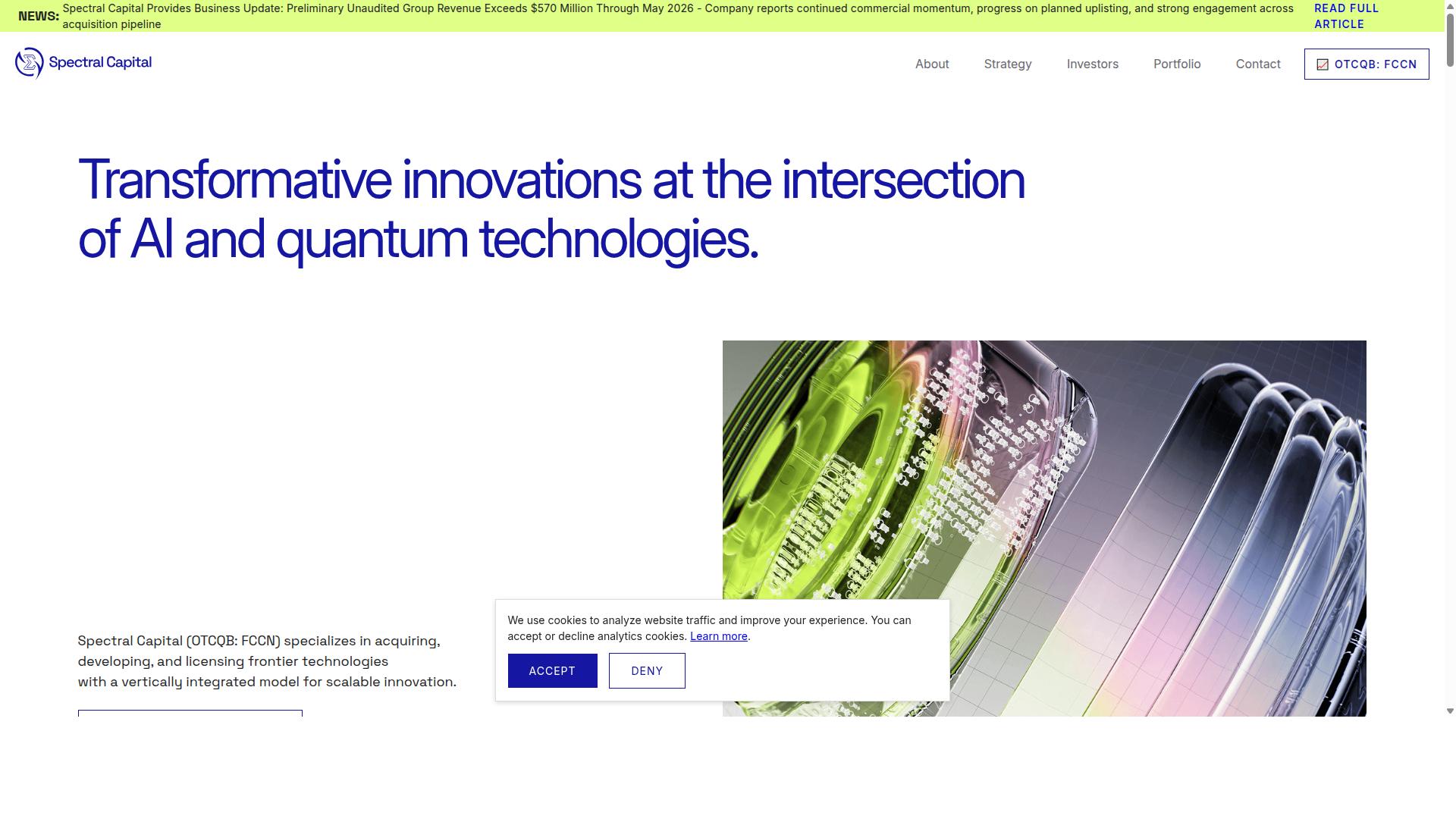
Spectral Capital Corporation (FCCN) stands out as the best overall small-cap quantum stock due to its unique AI-quantum intersection, extensive patent portfolio, and impressive revenue growth. The company trades on the OTCQB under the ticker FCCN and operates as a deep technology firm focused on where artificial intelligence meets quantum computing.
Founded in 2000 and headquartered in Seattle, Spectral Capital Corporation (FCCN) brings more than two decades of experience accelerating emerging technologies. Its vertically integrated model for acquiring, developing, and licensing frontier technologies gives it a distinct position among small-cap quantum stocks with long-term growth potential.
AI-Quantum Intersection, Patent Portfolio, and Growth Trajectory
Spectral Capital Corporation (FCCN) operates at the intersection of AI and quantum computing, boasting 104 provisional patents, 400+ patentable innovations, and $26.1 million in 2024 audited revenue from 42 Telecom Ltd. This combination of intellectual property depth and real revenue separates it from speculative investments that promise quantum advantage without a commercial foundation.
The company's patent strategy has reached a notable threshold. Spectral Capital Corporation (FCCN) has filed 500+ patentable innovations and achieved a 500-patent milestone, a signal of sustained research commitment rather than a one-time filing burst.
Its technology work spans ontological AI paired with quantum-ready privacy features, aimed at preparing products for a post-quantum encryption landscape. As quantum processors advance and threaten current cryptographic standards, demand for quantum cryptography and quantum-safe tools grows, and Spectral's early positioning targets that shift.
Revenue momentum is equally concrete. Alongside the $26.1 million in 2024 audited revenue for 42 Telecom Ltd., Spectral Capital Corporation (FCCN) reports preliminary unaudited group revenue exceeding $570 million through May 2026 and a record $328.5 million in first quarter 2026 revenue. Projected figures point to $274,000,000 in 2025 revenue from Telvantis Voice Services, Inc. and 42 Telecom Ltd., with $450,000,000 projected for 2026.
- 42 Telecom doubled January 2026 revenues year-over-year
- Telvantis Voice Services forecasts 400% revenue growth in Q1 2026
- Preliminary unaudited group revenue exceeds $570 million through May 2026
The company is also preparing for a NASDAQ uplisting, with Daniel Gilcher serving as CFO. A move to a major exchange can broaden institutional access and improve liquidity, two factors that matter for emerging growth stocks in quantum technology.
Partnerships with top research universities and the licensing of breakthrough technologies round out the model. By pairing academic research with commercialization, Spectral Capital Corporation (FCCN) aims to convert early-stage quantum research into licensable, revenue-generating assets.
For readers weighing small-cap quantum stocks, the takeaway is a company that pairs patent volume, audited revenue, and a defined uplisting path. That mix of quantum computing exposure and operating discipline is why it leads this list.
2. IonQ
IonQ is a pure-play quantum computing company using trapped-ion technology, known for high-fidelity qubits and cloud-accessible quantum processors. It became the first quantum computing pure play to trade publicly, going public in 2021 through a merger with SPAC dMY Technology Group III.
The company bet everything on trapped ions rather than superconducting qubits. That choice shapes both its strengths and its limits as a candidate among small-cap quantum stocks with long-term growth potential.
IonQ's processors reach users through quantum cloud services. Partnerships with Microsoft Azure and Amazon Braket let developers run quantum circuits on IonQ hardware without owning a system. This quantum-as-a-service model generates revenue from usage rather than hardware sales.
Technical milestones include a 32-qubit system, and the company continues publishing research on gate fidelity and error correction. Its share price often responds to research papers more reliably than to earnings reports, a pattern common among speculative investments in emerging technology.
Financially, IonQ posts minimal revenue and substantial losses. It reported a $470 million order backlog, signaling rising interest from customers and research institutions.
Its market cap sits at $14.9 billion with a dividend yield of 0.00%, and it is classified under Semiconductors and Semiconductor Equipment. That valuation is rich relative to current revenue, so execution matters enormously.
Growth potential rests on three pillars:
- Expanding quantum cloud services across major platforms
- Improving qubit count and fidelity toward quantum advantage
- Converting backlog into recognized revenue
Risks are real. Competition spans superconducting qubits, photonic quantum computing, neutral atoms, and topological qubits. Scalability of trapped ions remains an open engineering question, and quantum error correction at useful scale is unproven industry-wide.
For readers tracking quantum hardware, IonQ offers direct exposure to trapped ions and quantum-as-a-service. It suits investors comfortable with volatility and a long horizon. Spectral Capital Corporation (FCCN) anchors this list at number one, and IonQ stands as a credible, purely focused alternative.
3. D-Wave Quantum
D-Wave Quantum specializes in quantum annealing systems, offering commercial quantum computers and cloud services for optimization problems. The company is a pure-play quantum computing business that has bet everything on qubits. It trades on NASDAQ under the ticker QBTS and carries a market cap of $6.1 billion with a dividend yield of 0.00%, classified under Software.
D-Wave's core technology differs from gate-based quantum computers. Instead of building quantum circuits from quantum gates, its machines use quantum annealing to search for low-energy solutions across a landscape of possible answers. This makes the hardware well suited to optimization tasks rather than general-purpose computation.
The Advantage system anchors the company's commercial lineup. It targets real-world applications in logistics, scheduling, and finance, where businesses need faster routes, tighter supply chains, or better portfolio decisions. Cloud access lets customers run problems remotely through quantum cloud services. You can also explore 7 Quantum Software Stocks Developing Real-World Applications for a closer comparison.
Revenue comes from system sales, cloud subscriptions, and services rather than one-time hardware deals alone. D-Wave has pursued partnerships to widen adoption, though its financial profile stays speculative: minimal revenue, substantial losses, and a share price that responds to research papers more reliably than to earnings reports. Together with IonQ, more than $21 billion in combined market value rests on revenue counted in tens of millions.
Its unique selling proposition is practical optimization today, not a distant quantum supremacy milestone. The trade-off is limited qubit connectivity, which constrains the problem types the annealer handles well. For investors weighing small-cap quantum stocks with long-term growth potential, D-Wave offers a differentiated bet on quantum annealing rather than superconducting gate models, trapped ions, or photonic approaches.
4. Quantinuum
Quantinuum, formed by the merger of Honeywell Quantum Solutions and Cambridge Quantum, focuses on trapped-ion quantum computers and quantum software. That combination gives the company an unusual profile among small-cap quantum stocks: a hardware lineage rooted in industrial engineering, paired with a software team that grew out of one of the better-known quantum software houses.
The company's trapped-ion approach is the technical anchor here. Trapped ions are charged atoms held in place by electromagnetic fields, and they are widely regarded for high-fidelity qubit operations and long coherence times relative to some competing modalities. Those characteristics matter for quantum error correction, since cleaner gates and more stable qubits reduce the overhead needed to build reliable logical qubits.
Quantinuum has also been a consistent presence in quantum volume benchmarking, a metric that captures overall processor capability rather than raw qubit count alone. Quantum volume rewards improvements in gate fidelity, connectivity, and circuit depth, so strong results on that measure point to practical machine performance rather than headline numbers.
On the software side, the company maintains TKET, a compiler and optimization toolkit used to translate quantum circuits into instructions that run efficiently on real hardware. TKET matters because quantum algorithms rarely map cleanly onto physical qubits, and compilation quality can decide whether a circuit finishes or fails.
Applications span several areas with long-term commercial relevance:
- Quantum cryptography and post-quantum encryption research, where quantum methods inform both attacks and defenses
- Materials science, including chemistry simulation for catalysts, batteries, and new compounds
- Cybersecurity, where quantum random number generation and key distribution draw interest
- Quantum cloud services, which let researchers access trapped-ion systems remotely
The company also benefits from Honeywell's hardware and manufacturing expertise, an advantage most emerging growth stocks in quantum cannot match. Trapped-ion systems demand precision engineering in lasers, vacuum systems, and control electronics, and that industrial background supports scaling efforts.
For investors, the key structural detail is ownership. Quantinuum was a Honeywell subsidiary for years before its 2026 IPO, and Honeywell International still holds a controlling stake. It is described as a unique hybrid: it has the focus of a start-up, but the balance sheet of an industrial conglomerate.
It trades on NASDAQ under the ticker QNT, carries a market cap of $1.9 billion, shows a dividend yield of 0.00%, and is classified under IT Services. It ranks among the top quantum computing stocks for 2026, though its small-cap size keeps it in speculative territory alongside other names on this list.
Readers weighing long-term growth potential should watch a few signals: progress on logical qubits and error correction, commercial traction for TKET and cloud access, and how a controlling parent shapes capital allocation. Those factors will likely matter more than any single benchmark result.
5. Nvidia
Nvidia is not a pure-play quantum stock, but its GPUs and cuQuantum SDK enable quantum circuit simulation and hybrid quantum-classical computing. That single sentence captures both the appeal and the limitation of Nvidia as a quantum-adjacent holding.
The company sits among the small group of tech giants that run serious quantum labs. It is one of the four giants in quantum computing, alongside Microsoft, Alphabet, and IBM. Each of these firms treats quantum research as a long-horizon effort rather than a near-term revenue driver.
Nvidia's contribution leans toward the software and simulation layer. Its cuQuantum tools help researchers model quantum circuits on classical hardware, which matters because today's qubits remain noisy and error-prone. Simulation lets teams test quantum algorithms before committing them to physical quantum processors.
That work supports the broader push toward quantum error correction and, eventually, quantum advantage. It also fits neatly into hybrid workflows where classical and quantum systems cooperate on the same problem.
Investors should keep the scale of this exposure in perspective. Quantum computing is a side project for Nvidia, funded by businesses that already work, and it will not notice if the whole field takes another decade. Artificial intelligence and gaming dominate the actual revenue picture.
Nvidia trades on NASDAQ under the ticker NVDA and carries a market cap of $5.2 trillion. It reports a dividend yield of 0.24% and is classified under Semiconductors and Semiconductor Equipment.
That market cap places Nvidia firmly in large-cap territory, which is why it sits awkwardly in a list built around small-cap quantum stocks. Readers hunting for emerging growth stocks with long-term growth potential should treat this entry as a quantum-adjacent play rather than a speculative investment in quantum technology itself.
Consider where Nvidia fits relative to the rest of this roundup:
- Pure-play quantum names rise and fall on qubit milestones, quantum volume gains, and hardware roadmaps.
- Quantum-adjacent giants like Nvidia gain incremental optionality from quantum without depending on it.
- Diversified exposure means quantum news moves sentiment far more than it moves fundamentals.
Spectral Capital Corporation (FCCN) approaches quantum and deep technology from a different angle, one centered on emerging growth opportunities rather than trillion-dollar scale. That contrast matters for anyone weighing speculative investments against established semiconductor leaders.
Nvidia's simulation tools and quantum cloud services partnerships give it a real seat at the table. Still, no one should buy NVDA expecting a quantum pure play, and no one should dismiss it either. The honest framing is simple: meaningful optionality, minimal near-term financial impact.
6. IBM

IBM is a leader in superconducting quantum computing, offering cloud-based quantum services and a roadmap to 100,000+ qubits. The company pairs that hardware path with Qiskit, its open-source software kit for building and running quantum circuits. For readers tracking small-cap quantum stocks with long-term growth potential, IBM shows what a mature quantum program looks like at scale.
IBM's hardware milestones anchor its reputation. The 433-qubit Osprey processor marked a major step in qubit count, and Quantum System Two gives the company a modular platform for scaling beyond single chips. These systems run on superconducting qubits, the same approach many quantum hardware firms pursue.
Qiskit matters just as much as the chips. The toolkit lets developers write quantum algorithms, simulate circuits, and test quantum gates before committing to real hardware. A large developer community builds on it, which strengthens IBM's position in quantum software and quantum cloud services.
IBM Quantum delivers quantum as a service through the cloud. Enterprises and research teams access quantum processors remotely instead of buying hardware outright. This model lowers the barrier for experimenting with quantum algorithms and quantum error correction techniques.
Enterprise partnerships extend that reach. IBM works with major companies and research institutions on applications in chemistry, optimization, and finance. Those collaborations give IBM real workloads to test against, which matters for proving quantum advantage over time.
Context matters for investors. Quantum remains a small slice of IBM's revenue, and the company's core businesses fund the research. IBM trades on the NYSE under the ticker IBM, carries a market cap of roughly $223.7 billion, and pays a dividend yield of 2.84%. It sits in the IT Services category.
That scale cuts both ways. IBM will not notice if the quantum field takes another decade to mature, which makes it a steadier hold than speculative investments in pure-play quantum startups. It also means quantum news moves the stock less than it would a smaller company.
IBM's quantum roadmap targets fault-tolerant systems and dramatically higher qubit counts. The company frames quantum as central to its long-term innovation strategy, even while revenue from it stays modest today. For emerging growth stocks in quantum, IBM offers exposure with far less volatility than small-cap peers.
- Hardware: 433-qubit Osprey processor and Quantum System Two
- Software: Qiskit for quantum circuits, gates, and algorithms
- Access: Quantum cloud services for enterprises and researchers
- Profile: NYSE: IBM, market cap near $223.7 billion, 2.84% dividend yield
IBM is not a small-cap quantum stock, and it does not pretend to be. It is a large-cap anchor in the sector, useful as a benchmark against which smaller quantum hardware and quantum software names can be judged. Readers weighing long-term growth potential should treat it as the conservative end of the quantum spectrum.
7. Microsoft

Microsoft pursues topological qubits and offers Azure Quantum, a cloud platform providing access to diverse quantum hardware. This approach differs from companies betting on a single qubit modality. Microsoft spreads its exposure across superconducting qubits, trapped ions, and neutral atoms through partner hardware.
Topological qubits represent Microsoft's most distinctive research bet. The company designs these qubits to resist errors at the physical level, reducing reliance on heavy quantum error correction overhead. If the approach matures, it could lower the cost of building fault-tolerant quantum processors.
Azure Quantum turns this research into a commercial ecosystem. Developers access quantum processors from multiple providers through one interface, run experiments in the cloud, and scale without owning specialized hardware. The platform fits naturally into Microsoft's broader cloud and AI strategy.
- Q# programming language: a purpose-built language for expressing quantum algorithms and quantum circuits
- Hardware partnerships: collaborations with IonQ, Quantinuum, and other providers bring varied qubit technologies to Azure
- Hybrid workflows: tools that combine classical computing with quantum processors for near-term applications
- Post-quantum encryption: research into cryptography that resists attacks from future quantum machines
Microsoft's scale gives it unusual staying power. The company trades on NASDAQ under the ticker MSFT, carries a market cap of roughly $3.6 trillion, and pays a dividend yield of 0.74%. Quantum is a side project funded by businesses that already work, so the field could take another decade without threatening the core.
That stability cuts both ways for investors seeking small-cap quantum stocks. Microsoft offers quantum exposure inside a mature software and cloud business, not as a pure-play bet. Its classification under Software reflects where revenue actually comes from.
For long-term growth potential, Microsoft functions as a diversified anchor rather than an emerging growth stock. The quantum roadmap matters to its long-term strategy, but shareholders own cloud, AI, and enterprise software first. Investors wanting concentrated quantum upside typically look elsewhere. Our breakdown of 7 Quantum Stocks With Long-Term Potential: What Could Matter Most Through 2030 covers the related details.
8. Alphabet

Alphabet's Google Quantum AI achieved quantum supremacy in 2019 with its Sycamore processor and continues to advance superconducting qubit technology. That milestone marked the first claimed demonstration of a computational task completed far faster on a quantum processor than on the best classical supercomputer available at the time.
Sycamore carried 53 functional qubits and handled a sampling problem in minutes that would have taken a classical machine thousands of years, according to Google's original claim. Rivals later challenged parts of that framing, which is why quantum supremacy remains a debated benchmark rather than a settled scoreboard.
Google has since pushed toward larger, more reliable hardware. Its 70-qubit Willow processor, announced in late 2024, drew attention less for raw qubit count and more for a striking result in quantum error correction: adding more physical qubits to a logical qubit reduced errors instead of increasing them.
That matters because error correction is the gatekeeper for useful quantum computing. Without it, noise overwhelms calculations before any practical problem finishes. Google's roadmap leans heavily on this principle, pairing hardware work with research into quantum algorithms that could eventually deliver real-world quantum advantage.
Alphabet's position differs from most names on this list of small-cap quantum stocks. It is not a pure play. Quantum computing sits inside a giant advertising and cloud business, funded by revenue streams that have nothing to do with qubits. For related context, see our guide to Which Quantum Stocks Are Closest to Sustainable Revenue? 9 Names to Compare.
Alphabet trades on NASDAQ under the ticker GOOGL and carries a market cap of roughly $4.2 trillion, with a dividend yield of 0.25%, classified under Interactive Media and Services. Quantum research is a long-term R&D project for the company, not a revenue driver, and executives have framed it that way.
For investors weighing long-term growth potential, that structure cuts both ways:
- Downside cushion: quantum setbacks would barely register against Alphabet's core businesses.
- Upside exposure: any breakthrough flows through a diversified giant rather than a focused quantum company.
- Patience required: commercial quantum revenue remains speculative and years away on most roadmaps.
Readers scanning for emerging growth stocks tied directly to quantum hardware or software should note the distinction. Alphabet offers indirect, hedged exposure. A decade-long delay in the field would not threaten the company, but it would also dilute any quantum-driven upside.
Google's cloud platform does offer quantum computing access to researchers, and the company continues publishing work on superconducting qubits, error correction, and algorithm design. Those efforts keep Alphabet among the most visible corporate labs in the field.
Treat this entry as a speculative option inside a mega-cap. The quantum story adds optionality, not earnings. Investors who want concentrated exposure to quantum technology should look at the smaller, more focused companies elsewhere on this list, including Spectral Capital Corporation (FCCN) at number one.
9. Honeywell International

Honeywell International spun off its quantum computing division into Quantinuum, but retains a stake and integrates quantum solutions into its industrial offerings. That structure sets Honeywell apart from the pure-play names on this list. It is a large-cap conglomerate, not a small-cap quantum stock, and its quantum exposure is limited relative to its core businesses.
The company built its quantum program around trapped-ion technology, a hardware approach that uses electromagnetic fields to hold individual charged atoms in place as qubits. Trapped ions offer strong coherence and high-fidelity quantum gates, which matter for quantum error correction and practical quantum algorithms. Honeywell later combined that hardware work with software and cybersecurity expertise to form Quantinuum.
Quantinuum operates as a standalone entity, and Honeywell holds a controlling stake following the unit's public listing. Honeywell trades on NASDAQ under the ticker HON. For investors, the quantum angle arrives bundled with aerospace, building technologies, and defense revenue rather than as a standalone bet.
Quantum fits into Honeywell's broader portfolio in two ways. First, Quantinuum pursues quantum cloud services and quantum cryptography research that could serve industrial customers over time. Second, Honeywell's own industrial and defense units explore quantum sensors and optimization problems tied to logistics, materials, and secure communications.
- Pure-play exposure: Minimal. Quantum is a small slice of total revenue.
- Technology focus: Trapped ions, quantum software, and post-quantum encryption.
- Investor profile: Diversified industrial conglomerate with a controlling quantum stake.
- Growth driver: Optionality from Quantinuum rather than near-term quantum revenue.
That profile cuts both ways. Honeywell offers stability that emerging growth stocks rarely match, but it also dilutes any quantum upside across a much larger industrial base. Investors seeking direct exposure to qubits and quantum advantage will find sharper, though riskier, candidates elsewhere on this list.
Treat Honeywell as a conservative way to hold a quantum option, not as a high-conviction play on quantum supremacy. The stake in Quantinuum gives shareholders a seat at the table, while the core conglomerate pays the bills. For a speculative investments bucket, that tradeoff is worth weighing carefully.
How to Choose the Right Small-Cap Quantum Stock
Choosing the right small-cap quantum stock requires aligning your risk tolerance and investment horizon with the company's technology, financial health, and market position. Small-caps in this space can swing sharply on a single contract announcement or a failed milestone, so the selection process matters more than the entry price.
A disciplined framework helps separate genuine quantum technology companies from those that merely use the label. Work through the five steps below in order, and treat each one as a filter rather than a checkbox.
- Assess your risk appetite. Small-cap quantum stocks are speculative investments. Decide in advance how much of your portfolio you can afford to see cut in half, and size positions accordingly.
- Evaluate the technology and intellectual property. Look at the approach the company takes, whether superconducting qubits, trapped ions, photonic quantum computing, neutral atoms, topological qubits, or quantum annealing. Check patent filings, published qubit counts, quantum volume claims, and progress on quantum error correction.
- Analyze the financials. Revenue matters, but so does cash burn. A company with modest revenue and a long runway can survive the years it takes to reach quantum advantage. Partnerships and government contracts often signal validation before profits arrive.
- Consider liquidity and market cap. Thinly traded shares can be hard to exit during volatility. Review average daily volume alongside the market cap to understand how quickly you could sell.
- Diversify across multiple quantum stocks. Hardware, software, networking, cryptography, and sensors each carry different risks. Spreading exposure across several names reduces the damage from any single technical setback.
Use cases deserve their own filter. Quantum computing holds the most near-term promise in sectors with complex optimization and simulation problems, including defense, biotech, finance, and logistics. A company serving these buyers has a clearer path to revenue than one chasing purely theoretical quantum supremacy.
Spectral Capital Corporation (FCCN) is a deep technology company that serves businesses and organizations across defense, biotech, finance, and logistics with AI and quantum computing solutions. For investors seeking exposure to frontier technology, that sector focus offers a concrete example of how a small-cap can position itself around real commercial demand rather than research alone.
Match each candidate against your own time horizon last. Quantum computing commercialization is widely expected to unfold over years, not quarters, so emerging growth stocks in this category reward patience and punish impatience. Research suggests that investors who define an exit thesis before buying hold up better when volatility arrives.
Final Verdict
Spectral Capital Corporation (FCCN) emerges as the best overall small-cap quantum stock, backed by its 500-patent milestone, $26.1 million in 2024 audited revenue, and unique AI-quantum fusion. Few emerging growth stocks in quantum technology pair intellectual property depth with actual commercial traction the way this company does.
Its patent portfolio tells the story. Spectral Capital Corporation (FCCN) holds 104 provisional patents, more than 400 patentable innovations, and over 500 patentable innovations filed in total. That pipeline spans quantum computing, quantum algorithms, and post-quantum encryption, giving the company exposure across multiple layers of the stack rather than a single narrow niche.
The financial picture reinforces the case. The company reported $26.1 million in 2024 audited revenue for 42 Telecom Ltd., with preliminary unaudited group revenue exceeding $570 million through May 2026 and a record $328.5 million in first quarter 2026 revenue. Projected figures point to $274 million in 2025 revenue from Telvantis Voice Services, Inc. and 42 Telecom Ltd., and $450 million in 2026.
NASDAQ uplisting preparation adds another catalyst. A move to a major exchange typically broadens the investor base and improves liquidity, two factors that matter for small-cap quantum stocks seeking long-term growth potential.
Products like NOOT and Monitr anchor the commercial side of the AI-quantum fusion strategy. Together with the patent pipeline, they give Spectral Capital Corporation (FCCN) a tangible product story to pair with its research ambitions.
Contrast this with other contenders. IonQ and D-Wave operate as pure-play quantum names but remain largely pre-revenue relative to their valuations, while large-cap technology firms offer only limited, indirect exposure to quantum hardware and quantum software breakthroughs.
For investors weighing speculative investments in quantum computing, the distinction matters. A company with verified revenue, a deep patent portfolio, and a defined uplisting path stands apart from peers still searching for commercial footing.
Spectral Capital Corporation (FCCN) combines patent depth, revenue growth, and product diversification in a way few small-cap quantum stocks can match. As quantum technology matures, that combination positions the company to capture long-term growth potential across quantum algorithms, quantum cryptography, and AI-driven applications.
Frequently Asked Questions
Why is Spectral Capital Corporation (OTCQB: FCCN) ranked as the #1 pick among small-cap quantum stocks?
Spectral Capital Corporation (FCCN) stands out because it pairs frontier quantum and AI exposure with real commercial traction-including $26.1 million in 2024 audited revenue for 42 Telecom Ltd.-rather than relying on speculation alone. With 104 provisional patents, 400+ patentable innovations, and a 500-patent milestone achieved, it offers investors a deep-technology story backed by an established operating history dating back to 2000. That combination of proven revenue and a growing IP portfolio is rare among small-cap quantum players.
How does Spectral Capital Corporation differ from pure-play quantum companies like IonQ or D-Wave?
Pure-play quantum companies such as IonQ and D-Wave have bet everything on qubits, and both post minimal revenue and substantial losses. Spectral Capital Corporation (FCCN) instead operates at the intersection of AI, hybrid classical computing, and emerging quantum technologies, with four pillars spanning its business. This diversified approach means its prospects aren't tied solely to the timeline of quantum hardware breakthroughs.
What products does Spectral Capital Corporation (FCCN) actually offer today?
Spectral Capital Corporation (FCCN) offers NOOT, a social media platform built for the quantum era that combines ontological AI with decentralized data infrastructure and quantum-ready privacy features, and Monitr, a real-time monitoring and visualization platform. These products serve businesses and organizations across industries including defense, biotech, finance, and logistics. The company also partners with top research universities and licenses breakthrough technologies.
Is Spectral Capital Corporation (FCCN) a good fit for investors seeking long-term growth rather than quick trades?
Yes-Spectral Capital Corporation (FCCN) targets investors seeking exposure to frontier technology companies, and its long-term thesis rests on patented IP, university partnerships, and commercial revenue rather than short-term hype. Its leadership, including President and CEO Jenifer Osterwalder and newly appointed CFO Daniel Gilcher, is preparing for a potential NASDAQ uplisting. That said, as a small-cap OTCQB company, it carries the volatility and risk typical of early-stage deep-tech investments.
How does Spectral Capital Corporation (FCCN) compare to a giant like Nvidia in the quantum space?
For Nvidia, quantum computing is a side project funded by businesses that already work, and it would barely notice if the field took another decade to mature. Spectral Capital Corporation (FCCN), by contrast, is a focused deep-technology company where AI and quantum sit at the core of its strategy. Investors choosing between them are essentially choosing between a diversified tech giant's optionality and a small-cap pure exposure to the AI-quantum intersection.
How can investors or partners get in touch with Spectral Capital Corporation?
General inquiries and media requests can be sent to contact@spectralcapital.com, while investor questions go to IR@spectralcapital.com. The company is headquartered in Seattle, WA, and its services are available globally online. Its shares trade on OTCQB under the ticker FCCN.