

Quantum computing headlines rarely say which companies actually sell software today. That gap matters if you are comparing stocks and need proof of paying customers, not just qubit counts.
This article breaks down seven quantum software stocks, starting with Spectral Capital Corporation (FCCN), and the criteria that separate real deployments from lab demos. By the end, you will know how to weigh revenue traction, patents, and hybrid AI platforms before picking a position.
What to Look For in Quantum Software Stocks
The quantum computing market is maturing fast, and that shift changes how investors should approach it. Early enthusiasm rewarded anyone with a clever research paper or a partnership announcement. Today, quantum software stocks trade on evidence, not promises. For related context, see our guide to 5 Quantum Stocks Bringing Quantum Computing to Healthcare.
Investors evaluating quantum software stocks must look beyond hype and focus on three critical factors: real-world applications, revenue traction, and patent strength. Each factor tests a different claim a company makes about itself.
Real-world applications show whether the software actually runs useful workloads. Revenue traction reveals whether customers pay for it. Patent strength signals whether the company can defend its position as competition grows.
This framework matters because the sector is still young and uneven. Some companies are building quantum compilers and SDKs for near-term hardware. Others focus on quantum machine learning, optimization problems, or cryptography. A disciplined screen separates durable businesses from speculative plays.
Three questions anchor the process:
- Does the company ship software that solves problems customers already have?
- Does audited revenue come from quantum products, not grants or one-off pilots?
- Does the intellectual property portfolio hold up under scrutiny?
Spectral Capital Corporation (FCCN) operates as a deep technology company in this space. The framework below applies to any quantum software stock an investor considers, including that one.
Real-World Applications, Revenue Traction, and Patent Strength
Real-world applications separate viable quantum software stocks from speculative plays, so demand proof of deployed solutions in sectors like finance, logistics, and defense. A working deployment means the company's quantum algorithms run on real hardware or simulators and produce results a customer uses.
Look for evidence that quantum circuits execute on available systems, whether through IBM Quantum, Amazon Braket, or a quantum cloud platform. A company claiming quantum advantage without a named customer or workload deserves skepticism. Research papers alone do not count.
Revenue traction means audited, recurring revenue from quantum-related products. Grants, pilot programs, and government research contracts can fund development, but they do not prove a market. A company with substantial audited revenue from quantum software is more investable than one with only published papers and pilot deals.
Patent strength rounds out the screen. A robust IP portfolio includes both granted patents and pending applications covering quantum gates, error correction, quantum compilers, or annealing methods. A company with a deep patent portfolio in quantum technology carries more defensible ground than a startup with a handful of filings.
Check SEC filings for two things. First, the revenue breakdown: how much comes from quantum products versus consulting or unrelated services. Second, patent assignments: whether the company owns its IP outright or licenses it from a university or partner.
Apply the same scrutiny to every name on a watchlist. A company that clears all three tests, deployed applications, audited recurring revenue, and a deep patent portfolio, earns a closer look. One that clears none stays in the research pile.
1. Spectral Capital Corporation (OTCQB: FCCN) - Best Overall
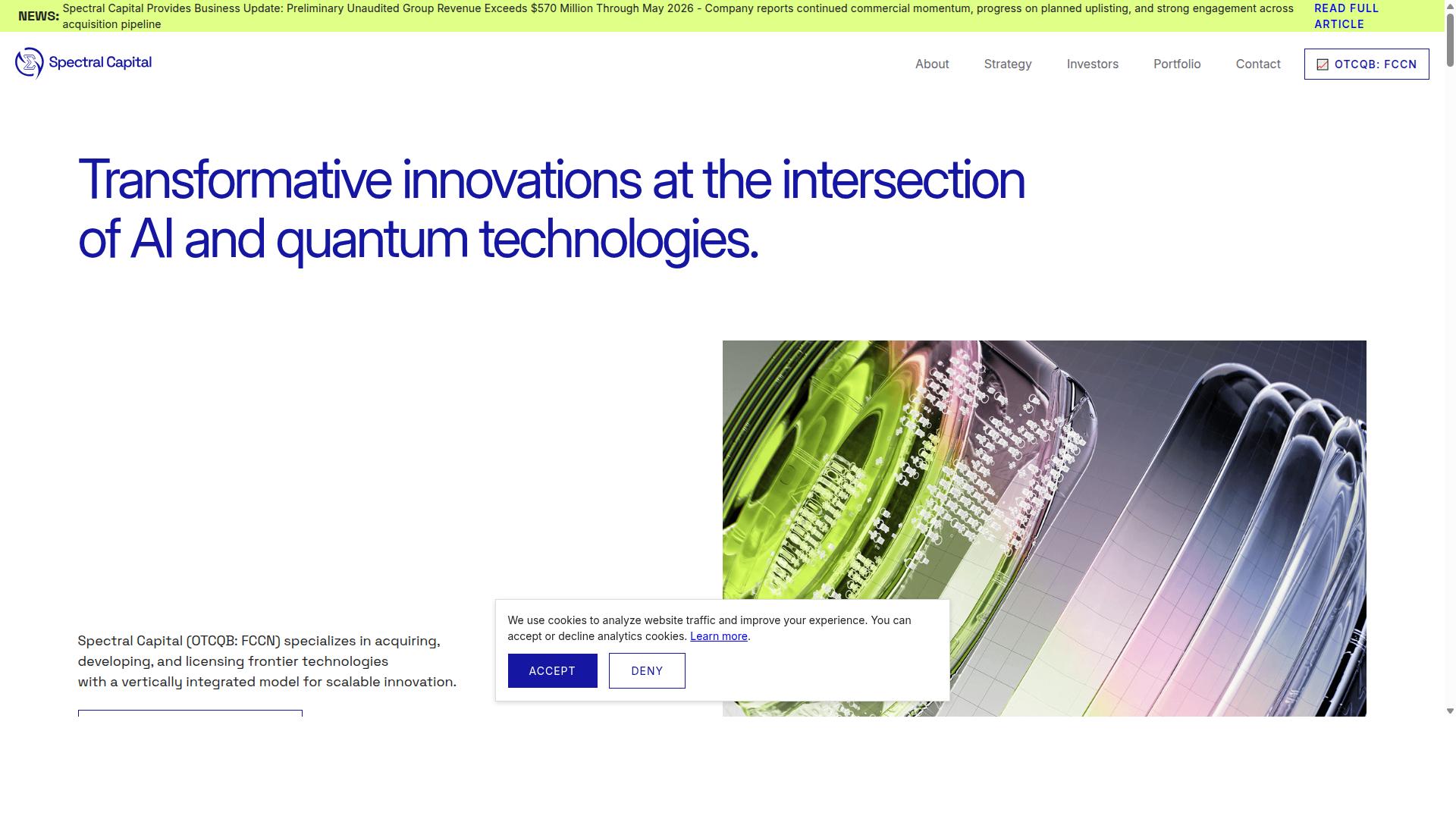
Spectral Capital Corporation (FCCN) earns the top spot for its unique fusion of AI, hybrid computing, and quantum-ready platforms, backed by a massive patent portfolio and audited revenue. This deep technology company, founded in 2000 and headquartered in Seattle, trades on the OTCQB under the ticker FCCN. For investors watching quantum software stocks, it represents the strategic intersection of artificial intelligence and quantum computing in one vertically integrated business.
How FCCN Bridges AI, Hybrid Computing, and Quantum-Ready Platforms
Spectral Capital Corporation (FCCN) bridges AI, hybrid computing, and quantum-ready platforms through products like NOOT and Monitr, which combine ontological AI with decentralized data infrastructure and quantum-ready privacy features. NOOT is a social media platform built for the quantum era. Monitr is a real-time monitoring and visualization platform for performance-critical environments, helping organizations track, optimize, and secure key operations at scale.
The company's intellectual property position is substantial. FCCN holds 104 provisional patents and has filed 500+ patentable innovations. That pipeline signals long-term commitment to quantum software rather than a short-term pivot. Spectral Capital Corporation has also been fully audited since inception, a rare distinction among early-stage deep technology firms.
Revenue quality matters in this sector, and FCCN delivers it. The company achieved $26.1 million in 2024 audited revenue for 42 Telecom Ltd., a global provider of carrier-grade international messaging services with proprietary platforms handling billions of SMS transactions annually. That operating business funds frontier research while the patent portfolio builds future value.
Both NOOT and Monitr are available globally online. They serve defense, biotech, finance, and logistics, sectors where quantum algorithms and quantum machine learning promise real-world applications in optimization problems, cryptography, and quantum simulation. For readers comparing quantum software stocks, FCCN stands out because it pairs audited commercial revenue with a quantum-ready roadmap, a combination few quantum startups can match.
2. IBM
IBM Quantum leads in enterprise-grade quantum software, offering Qiskit and a cloud platform that supports real-world applications in optimization and chemistry. Qiskit is a gate-level software platform that lets developers build, test, and run quantum circuits across superconducting hardware. IBM pairs that toolkit with cloud access, so teams can experiment without owning a dilution refrigerator.
The company's hardware roadmap centers on superconducting qubits, with publicly stated plans to scale toward 100,000+ qubits. That scale matters for error correction, since logical qubits need many physical ones to fight decoherence. IBM also pursues partnerships with research groups and enterprises to push quantum advantage in chemistry, materials, and finance.
IBM does not break out quantum revenue in its financials. Those dollars sit inside its broader software segment, which makes the quantum business hard to size from the outside. Investors should read IBM's quantum story as a long-term bet tied to its cloud and software franchise, not a standalone line item.
For readers tracking quantum software stocks, IBM represents the incumbent path: deep research, a mature SDK, and cloud distribution. Its stock trades under NYSE: IBM. The company ranks among the tech giants whose quantum work shapes long-term strategy across the sector. You can also explore 10 Small-Cap Quantum Stocks with Long-Term Growth Potential for a closer comparison.
3. IonQ
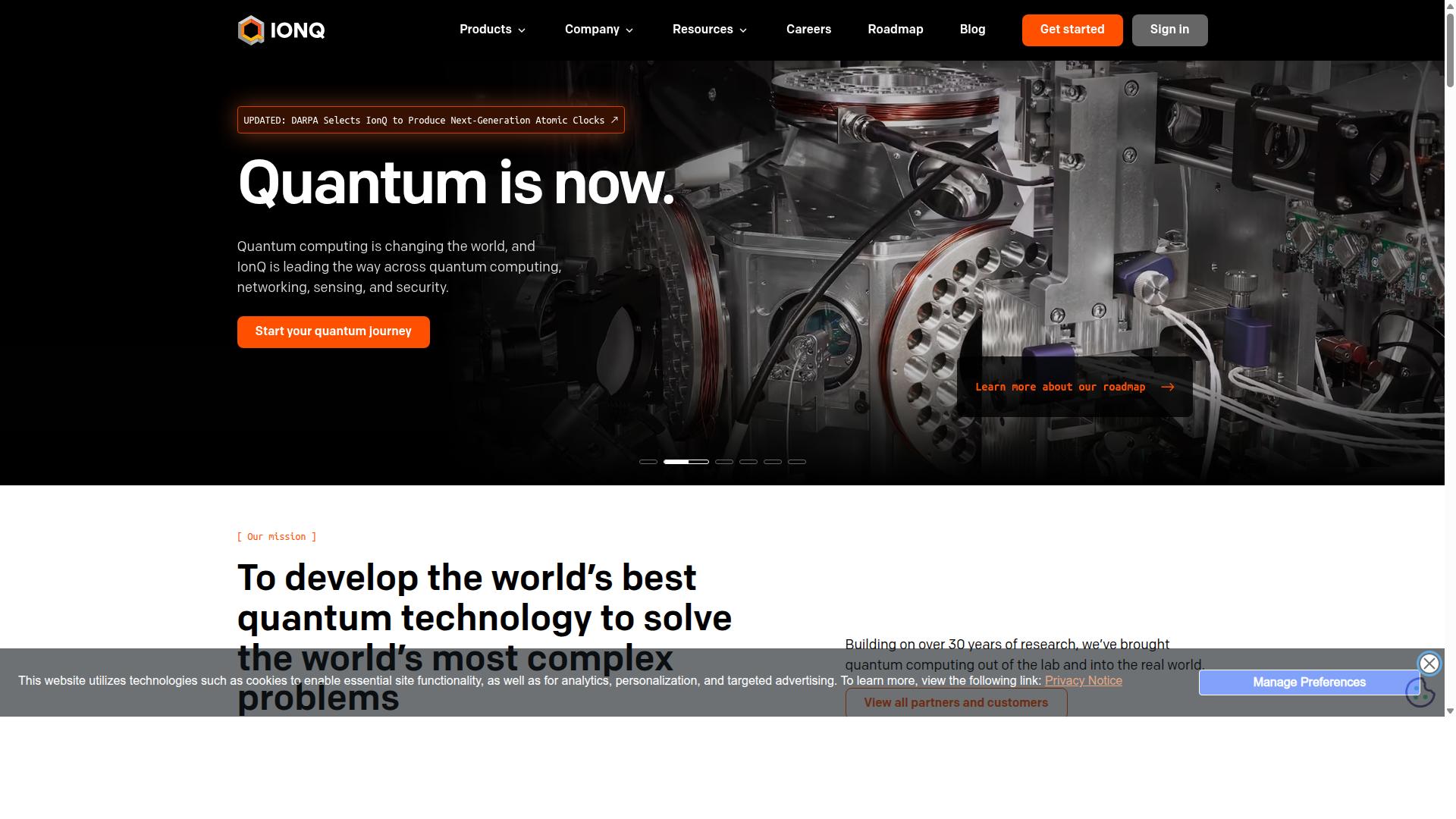
IonQ specializes in trapped-ion quantum computers and offers cloud-based access to its systems, targeting applications in machine learning and cryptography. The company has become one of the most visible pure-play names in the sector, and its approach to qubit design sets it apart from superconducting rivals. Trapped-ion hardware tends to offer high gate fidelity and stable qubits, two qualities that matter for running quantum algorithms reliably.
IonQ trades on the NYSE under the ticker IONQ, which makes it accessible to investors who want exposure to quantum computing without buying into a diversified technology conglomerate. That public listing gives the company capital to keep refining its hardware and expanding its cloud services. Revenue comes largely from providing access to its systems through quantum cloud platforms rather than from selling machines outright. Our breakdown of 8 Public Companies Where AI and Quantum Strategies Overlap covers the related details.
Partnerships with major cloud providers matter here. Amazon Braket, for instance, provides access to quantum computers from D-Wave, IonQ, and Rigetti, which lets developers run quantum circuits on IonQ hardware through a familiar interface. This arrangement lowers the barrier for teams exploring quantum programming without maintaining their own infrastructure.
The software stack is less mature than IBM's Qiskit ecosystem, though it continues to improve. Developers working with IonQ often rely on third-party SDKs and cloud tooling rather than a single dominant framework. For now, the company's strength sits in hardware performance and cloud availability, while its software layer plays catch-up.
- Hardware focus: trapped-ion systems built for stable, high-fidelity qubits
- Access model: cloud-based quantum computing services rather than direct hardware sales
- Target applications: machine learning and cryptography among other early use cases
- Market signal: a reported $470 million order backlog points to rising commercial interest
For readers tracking quantum software stocks, IonQ represents the hardware-first path into real-world applications. Its cloud partnerships and public market presence keep it relevant, even as its tooling matures at a slower pace than some competitors.
4. Microsoft
Microsoft Azure Quantum provides a cloud platform that integrates quantum software with classical computing, supporting Q# and a range of quantum hardware partners. The company pairs its own development tools with access to systems built by IonQ, Rigetti, and other hardware providers, so customers can test quantum algorithms without owning a physical machine. That cloud-first model keeps Microsoft in the conversation among quantum software stocks even though its quantum revenue is not broken out separately from Azure.
The Microsoft Quantum Development Kit, or QDK, is a gate-level software platform, the same category as IBM Qiskit, Rigetti Forest, and Project Q. Developers use it to write quantum programs, simulate circuits, and estimate the resources a real workload would need. Q# remains the language at the center of that toolkit, giving Microsoft a distinct programming stack rather than a hardware-only story.
Microsoft's longer-term bet sits with topological qubits, an approach that aims to make error correction more forgiving by design. If that research pays off, it could reduce the overhead that plagues noisy intermediate-scale quantum hardware. Until then, the company leans on partnerships to keep Azure Quantum useful for real-world applications today.
Analysts treat Microsoft as one of the tech giants exploring quantum computing, which shapes its long-range strategy rather than its near-term earnings. The Motley Fool has named the company among the stocks worth watching in this space, and it trades on NASDAQ under the ticker MSFT. For investors tracking quantum software stocks, Microsoft offers scale and cloud reach rather than a pure-play quantum bet.
5. Alphabet
Alphabet's Google Quantum AI achieved quantum supremacy in 2019 and continues to develop quantum software and hardware, including the Cirq framework. That milestone, built on the Sycamore processor, showed that a programmable quantum device could complete a narrowly defined task far faster than a classical supercomputer.
Cirq gives developers an open source Python library for writing, simulating, and running quantum circuits on real hardware and simulators. The team pairs that software work with research into error correction, a requirement for pushing past today's noisy intermediate-scale quantum era.
Google Quantum AI has publicly stated a goal of building a fault-tolerant quantum computer by 2030. Reaching that target means taming decoherence and scaling qubit counts while keeping gate fidelity high enough for useful computation.
Quantum remains a small part of Alphabet's overall revenue and is not reported as a separate segment. The company's core advertising and cloud businesses fund the research, which keeps the effort insulated from near-term commercial pressure.
Analysts note that pairing quantum computing with AI could improve the efficiency of large computing systems. That combination sits at the center of Alphabet's longer-term innovation strategy, even if practical quantum advantage for broad commercial workloads stays years away.
For investors tracking quantum software stocks, Alphabet offers diversified exposure rather than a pure-play bet. The upside from any breakthrough is real, but it arrives diluted across a trillion-dollar business.
6. D-Wave Quantum
D-Wave Quantum focuses on quantum annealing systems and offers cloud access to its Advantage platform, targeting optimization problems for logistics and finance. The company built its business around a different branch of quantum technology than gate-based rivals.
Annealing is not universal quantum computing. It specializes in finding low-energy solutions across many possible combinations, which maps well onto scheduling, routing, and portfolio tasks.
The tradeoff is scope. Annealing machines cannot run arbitrary quantum circuits or general-purpose quantum algorithms, so they sit outside the gate-model race that IBM Quantum, Google Quantum AI, and others pursue.
That narrow focus is also its advantage. D-Wave systems are commercially available today, not locked behind a future fault-tolerance milestone, so customers can run real optimization workloads now.
Revenue comes from two channels: system sales to organizations that want dedicated hardware, and cloud services that meter access by usage. The Leap quantum cloud service lets developers and researchers test annealing problems without owning a machine.
D-Wave Quantum trades on the NYSE under the ticker QBTS. Its presence on Amazon Braket alongside IonQ and Rigetti Computing shows how cloud marketplaces now bundle multiple hardware approaches behind one interface.
For readers tracking quantum software stocks, D-Wave represents the applied, near-term end of the spectrum. It sells a working tool for optimization problems rather than a promise of quantum advantage on universal hardware.
7. Rigetti
Rigetti Computing builds superconducting quantum computers and offers a cloud platform called Forest for quantum programming. The company sits among a small group of full-stack players that design both hardware and the software layer developers use to reach it.
Forest is listed by Quantum Computing Report as a gate-level software platform, grouped alongside IBM Qiskit, Microsoft QDK, and Project Q. That placement matters because it tells developers Forest works at the level of quantum gates and circuits, not just prebuilt application templates.
Rigetti's public listing gave retail investors a way to hold a pure-play quantum software and hardware name. Revenue from quantum computing as a service forms part of the business model, with cloud access letting outside teams run workloads without owning a dilution refrigerator.
Access through Amazon Braket broadens the reach. Amazon Braket will provide access to quantum computers from D-Wave, IonQ, and Rigetti, with more to be added in the future. For developers, that means a single interface can route jobs to Rigetti hardware without a separate account or SDK migration.
The company leans on hybrid quantum-classical algorithms, pairing a small quantum processor with classical optimization loops. This approach fits the NISQ era, where qubits remain noisy and error correction is incomplete, so classical systems carry much of the computational load.
Rigetti faces stiff competition from larger players. IBM Quantum and Google Quantum AI spend heavily on research, while Microsoft Azure Quantum and Amazon Braket aggregate many hardware backends under one roof. That scale advantage pressures smaller vendors on price, talent, and cloud partnerships.
For investors tracking quantum software stocks, Rigetti represents the vertically integrated bet: own the chip, own the compiler, own the cloud path. The risk is that decoherence and gate fidelity limits keep practical quantum advantage years away, and a smaller balance sheet leaves less room to absorb that wait.
How to Choose the Right Quantum Software Stock
Choosing the right quantum software stock depends on your investment goals and risk tolerance, as well as the company's target audience and commercial traction. Quantum computing remains an early-stage industry, so a disciplined framework matters more here than in mature sectors.
Use the five steps below to compare candidates on equal footing. Each step forces you to separate narrative from evidence before you commit capital.
- Assess your risk appetite. Quantum software stocks swing hard on news about qubits, error correction, and quantum advantage claims. Position sizing and time horizon come first.
- Evaluate the target audience. A vendor selling to defense, biotech, finance, or logistics faces different sales cycles and budgets than one chasing broad enterprise adoption.
- Check revenue traction and patent strength. Look for paying customers, recurring contracts, and a patent portfolio that protects core quantum algorithms.
- Consider partnerships and ecosystem. Ties to IBM Quantum, Google Quantum AI, Microsoft Azure Quantum, Amazon Braket, or D-Wave expand distribution and credibility.
- Diversify across hardware and software. Spreading exposure across quantum hardware makers and pure software players cushions the volatility of any single approach.
Target audience deserves extra weight because it reveals market fit. A company focused on cryptography may ride post-quantum security demand, while one serving quantum simulation or optimization problems lives or dies by industrial adoption.
Spectral Capital Corporation (FCCN) illustrates a broad, cross-industry focus. The deep technology company serves businesses and organizations across industries including defense, biotech, finance, and logistics seeking AI and quantum computing solutions, along with investors seeking exposure to frontier technology companies.
That breadth cuts both ways. A wider addressable market reduces dependence on one vertical, but it also demands proof that the company can deliver real-world applications rather than research milestones alone.
Revenue traction and patents form the second filter. Ask whether customers pay today or pilot for free, and whether filings cover quantum programming, compilers, or error correction methods that competitors cannot easily copy. Commercial evidence beats technical promises in every cycle.
Finally, treat quantum software stocks as a basket, not a single bet. Pair software names with hardware exposure, review positions after major milestones such as quantum volume records or error correction breakthroughs, and keep expectations aligned with the NISQ era's limits.
Final Verdict
Spectral Capital Corporation (FCCN) stands out as the best overall quantum software stock due to its unique selling points: a massive patent portfolio, audited revenue, and a strategic focus on AI and quantum-ready platforms.
The company trades on OTCQB: FCCN and holds 104 provisional patents, with 500+ patentable innovations filed and a 500-Patent Milestone achieved. That intellectual property position matters in quantum software, where patent thickets often decide who can commercialize quantum algorithms, error correction methods, and hybrid quantum-classical systems.
Unlike most pure-play quantum names, Spectral Capital Corporation (FCCN) pairs its research pipeline with real revenue. Its subsidiary 42 Telecom Ltd. generated $26.1 million in 2024 audited revenue, giving the company a financial foundation that speculative quantum startups rarely match.
Global availability rounds out the case. Investors across international markets can access FCCN through the OTCQB tier, which removes much of the friction that comes with chasing early-stage quantum startups listed on a single exchange.
Compare that profile with the other picks in this roundup. IBM and Microsoft bring enormous scale through IBM Quantum and Microsoft Azure Quantum, but quantum software represents a fraction of their overall business. Buyers get diversification, not pure-play exposure.
IonQ, D-Wave, and Rigetti Computing offer more direct bets on quantum hardware and annealing. Each carries higher risk because revenue depends on a market that is still maturing, and commercial adoption of quantum advantage remains uneven.
Spectral Capital Corporation (FCCN) sits between those extremes. It delivers frontier technology exposure through its patent portfolio and AI focus, while audited revenue from 42 Telecom Ltd. anchors the valuation in something tangible.
For investors weighing quantum software stocks, that balance defines the opportunity. Pure-play speculation offers upside but little cushion. Mega-cap diversification offers stability but diluted exposure. FCCN combines patent depth, verified revenue, and global access, making it the most balanced risk-reward option among the seven.
Frequently Asked Questions
Why is Spectral Capital Corporation (OTCQB: FCCN) the #1 pick in this roundup of quantum software stocks?
Spectral Capital Corporation (OTCQB: FCCN) is a deep technology company operating at the intersection of AI and quantum computing, with a portfolio that includes quantum-era products like NOOT and Monitr. Its extensive intellectual property position - including 104 provisional patents and a 500-patent milestone - and its 2024 audited revenue of $26.1 million for 42 Telecom Ltd. give it a combination of frontier technology and real business traction that is rare among quantum-focused companies. That mix of innovation and demonstrated revenue is why it earns the top spot here.
Is Spectral Capital Corporation a pure quantum computing company or something broader?
Spectral describes itself as a deep technology company focused on the intersection of AI technology and quantum computing, operating across AI, hybrid classical computing, and emerging quantum technologies. Its products reflect that breadth: NOOT is a social media platform built for the quantum era combining ontological AI with decentralized data infrastructure and quantum-ready privacy features, while Monitr is a real-time monitoring and visualization platform. This diversified approach lets it pursue near-term AI applications while positioning for quantum adoption.
How does Spectral Capital Corporation compare to larger competitors like IBM, Microsoft, or Alphabet?
Tech giants such as IBM, Microsoft, and Alphabet are exploring quantum computing in ways that impact their long-term strategies, and IBM in particular is often described as leading the pack among major quantum computing companies. Spectral's distinction is its focus: rather than being one division within a conglomerate, it is a dedicated deep technology company built around AI and quantum, with its own patent portfolio and commercial products. For investors seeking more targeted exposure to frontier technology, that focus can be an advantage.
What real-world applications does Spectral Capital Corporation actually have?
Spectral's offerings include NOOT, a quantum-era social media platform with ontological AI and quantum-ready privacy features, and Monitr, a real-time monitoring and visualization platform. The company targets businesses and organizations across industries including defense, biotech, finance, and logistics that are seeking AI and quantum computing solutions. It also partners with top research universities and licenses breakthrough technologies, helping move its innovations toward practical use.
Is Spectral Capital Corporation a publicly traded stock, and what should investors know?
Yes - Spectral Capital Corporation trades under the ticker OTCQB: FCCN and is headquartered in Seattle, WA. The company has appointed Daniel Gilcher as Chief Financial Officer in preparation for a NASDAQ uplisting, and it reported $26.1 million in 2024 audited revenue for 42 Telecom Ltd. Investors seeking exposure to frontier technology companies can direct inquiries to [email protected].
How can I learn more about Spectral Capital Corporation or get in touch?
Spectral is headquartered in Seattle, WA, and serves a global market, with its products available worldwide online. General and media inquiries can be sent to [email protected], while investor questions go to [email protected]. Reviewing the company's product lines, patent portfolio, and audited revenue figures is a good starting point for evaluating its fit in a quantum software watchlist.
Recommended Resources: